The humid Florida air hanging over Hard Rock Stadium this week carries a weight that is far bigger than the typical pre-game jitters of a National Championship.
On Monday night, the Indiana Hoosiers step into uncharted territory with a chance to become the first 16-0 team in the modern era of college football.
To find another team that achieved a 16-0 record, one has to look 132 seasons ago, when the Yale Bulldogs became undefeated national champions in a sport that was an unrecognizable hybrid of rugby and wrestling played by men wearing leather caps.
But this isn’t just a quest for a perfect season.
It is a seismic shift that signals the official end of the “blue-blood” monopoly in college football.For over a century, college football was viewed as a sport dominated by only a handful of teams. If you weren’t born into football royalty like the Alabamas, Ohio States, and Georgias of the world, you were viewed as a stepping stone.
Indiana, a program that entered this season with the most losses in FBS history, was the ultimate stepping stone.
Then came the revolution.
If Indiana lifts the trophy on Monday night, the sport doesn’t just change; it officially resets.
The architect of the emerging superpower in college football is Curt Cignetti, a man who declares himself both the head coach and the General Manager of the Indiana Football Program.
Cignetti’s approach to roster-building signals a radical change in recruiting. Cignetti doesn’t subscribe to the idea of “star-chasing” or recruiting the highest-ranked players in a respective class. Instead, he sticks to his mantra, “production over potential,” which has helped turn his roster, ranked 72nd in the country by 247Sports Team Talent Composite, into one of the most feared college football teams of all time.
Cignetti’s player evaluation is strict and clinical. He doesn’t care about how much a player can bench press or how fast a high school senior can run a 40-yard dash time if the player isn’t a proven winner.
Instead, Cignetti is looking for veteran athletes who have played upwards of 30 college football games. These players fit the mold of the Indiana Football Program and have enough experience, size, and strength to overpower a young five-star teenager completely.
These program-changing players continue to make the Hoosiers the most disciplined team in college football, and it makes sense.
This is the new blueprint for college football.
Why wait three years for a five-star freshman to develop?
In Curt Cignetti’s system, Indiana’s copious NIL resources are leveraged to build a roster of game-proven veterans.
Cignetti’s roster holds a large contingent of fourth and fifth-year players, many of whom followed him from James Madison. They are older, faster, stronger, and more disciplined than the teams they have spent the last five months embarrassing.
Curt Cignetti hasn’t achieved success on his own.
Cignetti has had a coaching staff defined by a level of loyalty foreign to college football. Defensive Coordinator Bryant Haines and Offensive Coordinator Mike Shanahan have been working under Curt Cignetti for over a decade. They have had stops at Indiana University Pennsylvania (IUP), Elon, James Madison, and finally Indiana.
Haines and Shanahan are both primary play callers for their respective units, as Cignetti has fully embraced his General Manager role in Bloomington.
The staff continuity has allowed the Hoosiers to install more complex systems that puzzle opponents.
Haines built a defense that is a statistical juggernaut, allowing just 11.07 points per game and leading the charge with 45 total sacks.
Indiana’s “no-names” have become game-wrecking nightmares for opposing offenses; Rolijah Hardy leads the team with 98.0 total tackles and 8.0 sacks, while Isaiah Jones has been a disruptive force for the Hoosiers defense, adding 15.5 tackles for loss.
On the other side of the ball, Shanahan has engineered an offense that averages a mind-boggling 42.6 points per game.
The efficiency is even more staggering, with a 58.15% third-down conversion rate that effectively drains the life and momentum out of opposing defenses.
While the system provides the framework, it requires a unique field general to execute the vision.
Looking dead in the eye of a hurricane is Heisman Trophy Winner Fernando Mendoza.
Mendoza, who is the shining light at the center of the storm for Indiana, returns home to Miami, his hometown, to play in the biggest game of his life.
The former three-star recruit from Christopher Columbus High School is viewed as a Cignetti success story. Mendoza was overlooked out of high school and passed up by countless programs, including his dream school, Miami.
Mendoza had no choice but to leave home.
Ultimately, Fernando Mendoza had to develop, and that’s precisely what he did at Cal before Curt Cignetti identified him as the perfect quarterback for his system at Indiana.
Since that day, Fernando Mendoza has never looked back.
He didn’t just win the Heisman Trophy; he conquered it.
He led the Hoosiers on multiple game-winning drives against great teams like Oregon, Iowa, Penn State, and Ohio State. Not only did he step up in the clutch, but his accuracy and efficiency were put on full display as Mendoza has thrown for 3,349 yards and 41 touchdowns with only six interceptions.
Mendoza managed five games where his touchdown total exceeded his incompletions, which is a record that may never be touched again.
While Mendoza’s on-field accolades are impressive and put him in exclusive categories across the history of college football, he has proved himself to be a locker room leader and a role model for young fans across the country.
His infectious smile, happy personality, and gritty play propel the Indiana Hoosiers to new heights in college football.
On Monday, he faces the Miami Hurricanes, the team he nearly upset while at Cal a year ago, before exiting the game due to a hit that left him momentarily unconscious before being forced to leave the game in a narrow one-point loss.
For Mendoza, this isn’t just a game; it’s a homecoming for a player who has become the face of a university and a new-age athlete who embraces the idea that where you start matters less than how you are developed.
Furthermore, Indiana’s rise is also a masterclass in resource management and fundraising.
Billionaire alumnus Mark Cuban hasn’t just been donating to the program; he has been investing in the future of Indiana football, seeking the same return on investment as in all his other business deals, which have helped him accrue over $ 9 billion in total revenue.
Cuban, who was the longtime majority owner of the Dallas Mavericks, compared Indiana’s NIL efforts to the NBA salary cap, where Curt Cignetti will spend money to slot players into specific roles rather than just bidding on the flashiest players.
This investment from Indiana fans across the country sees the program in a reloading phase rather than a rebuilding phase.
Indiana currently holds the nation's No.1 transfer portal class according to On3, before even playing in the national championship. They have turned a college program into a professional front office.
Athletic Director Scott Dolson’s strategy with spending has allowed Indiana to outspend traditional blue-bloods not by being the richest or having the most recruiting pull, but by being the most methodical program in college football.
A victory on Monday would cement the Big Ten’s total takeover of the sport.
With Michigan winning in 2023 and Ohio State in 2024, an Indiana win in 2025 is a historic "Three-Peat" for the conference.
But more importantly, it proves that the Big Ten has found a way to win without relying on a single powerhouse. It tells the SEC that the geographic monopoly in college football is over.
The Big Ten is no longer a two-horse race; it’s a conference where a program like Indiana can rise from the cellar to the summit in 24 months.
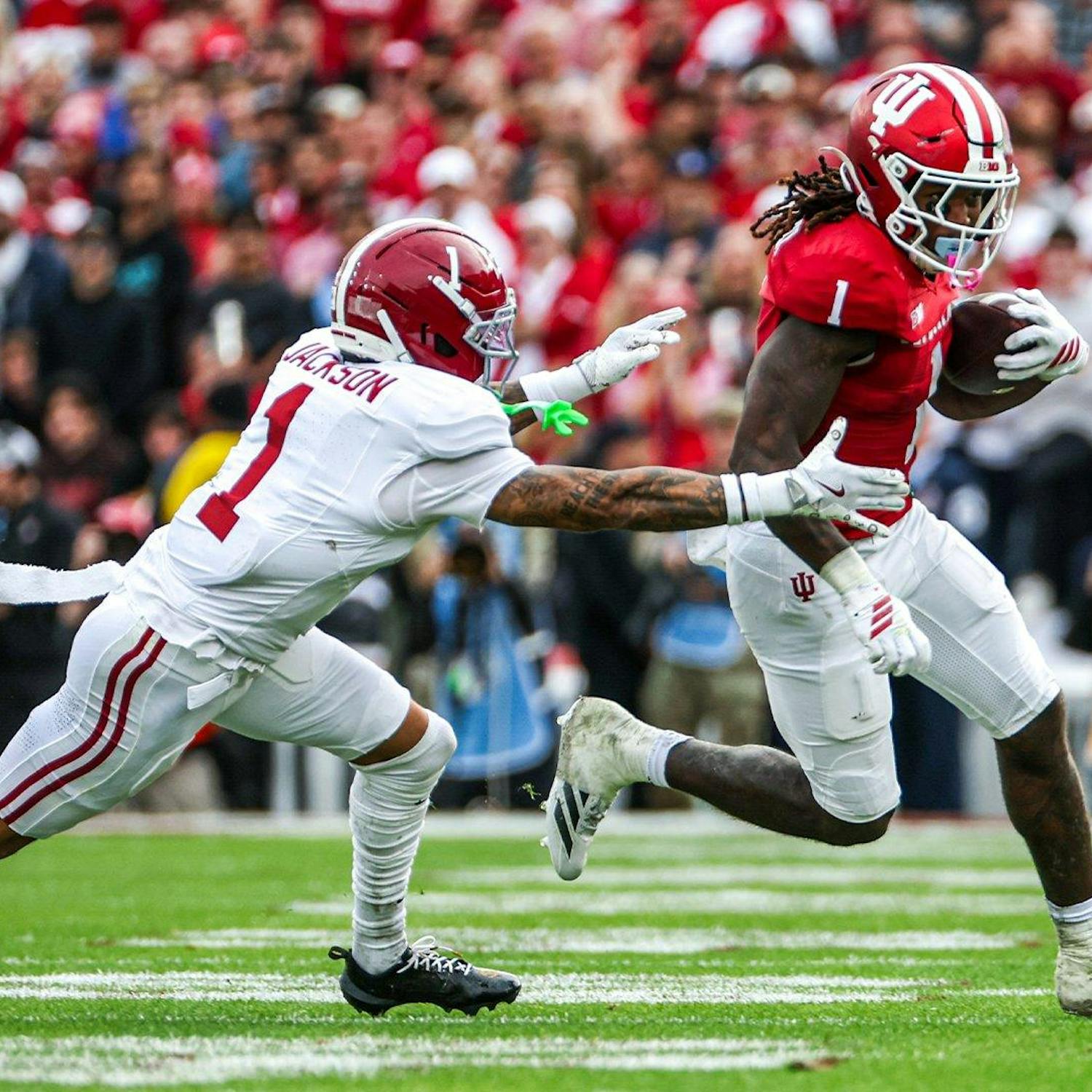
By crushing perennial powerhouse Alabama (38-3) in the Rose Bowl, the most prestigious bowl game in the sport, and Oregon (56-22) in the playoffs, Indiana has proved that, for a program with three prior all-time bowl wins, their dominance is not a fluke.
To understand the scale of dramatic change in college football, one must look at the 1894 Yale Bulldogs. Even the modern benchmarks of dominance are being rewritten.
While the 2019 LSU Tigers (15-0) and the 2020 Alabama Crimson Tide (13-0) defined offensive explosion by averaging over 48 points per game, they did it while giving up approximately 20 points per game.
The 2025 Hoosiers are dominating the modern game, but with a defensive intensity that the modern benchmarks simply didn’t possess.
The Indiana Hoosiers have outscored their opponents 639 to 166 this season.
They hold a ground game that churns out 218.3 yards per game, led by Roman Hemby (1,060 yards) and Kaelon Black (960 yards), all while having a Heisman Trophy winner at quarterback in Fernando Mendoza, throwing to offensive weapons, Elijah Sarratt, Omar Cooper Jr., and Charlie Becker.
The Hoosiers are incredibly well coached and disciplined; they have lost only one fumble in the entire season and play each down from scrimmage with the same unrelenting intensity.
Simply put, this team doesn’t make mistakes.
For those not paying attention to the changing tides or still dismissing Indiana's meteoric rise to the top of the sport, college football giants of old will be rooting for Miami because Miami feels familiar.
Miami is “The U.” They are the party, the neon, the swagger, and the winning tradition. They represent how college football used to be.
Indiana is the future.
Win or lose, the Hoosiers have already changed the sport at its core.
They have exposed vulnerabilities of the old guard and provided a blueprint for every underdog in the country.
They have shown that you can take the losingest program in history and, in two years, turn it into a 15-0 juggernaut using nothing but coaching continuity, clinical scouting, talent development, and strategic NIL investment.
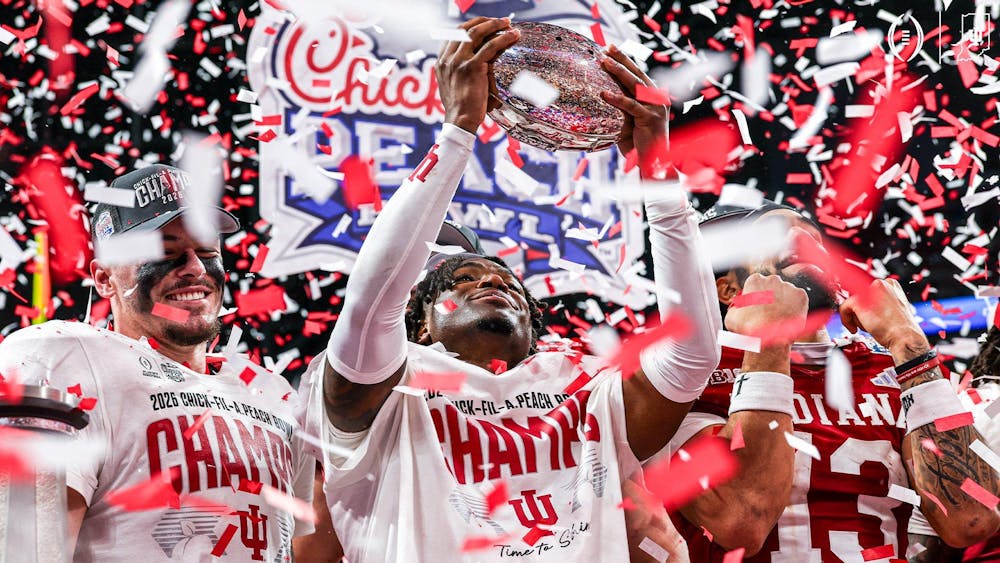
But a College Football Playoff National Championship win? A win makes that blueprint gospel.
On Monday night, the “basketball school” from Bloomington, Indiana, has the chance to become the greatest college football team in the modern era.
And if they do, the sport of college football will wake up on Tuesday morning to a brand new world.