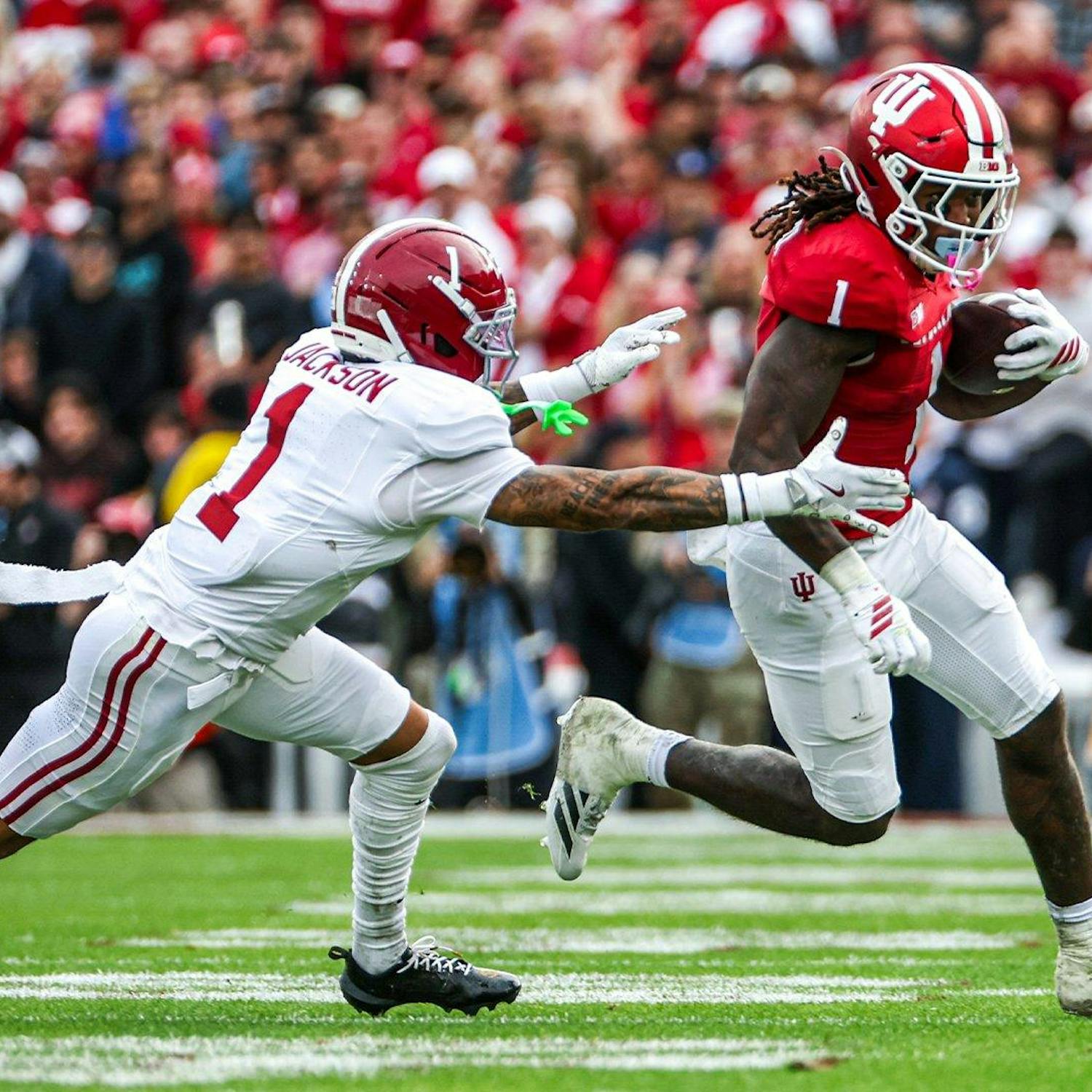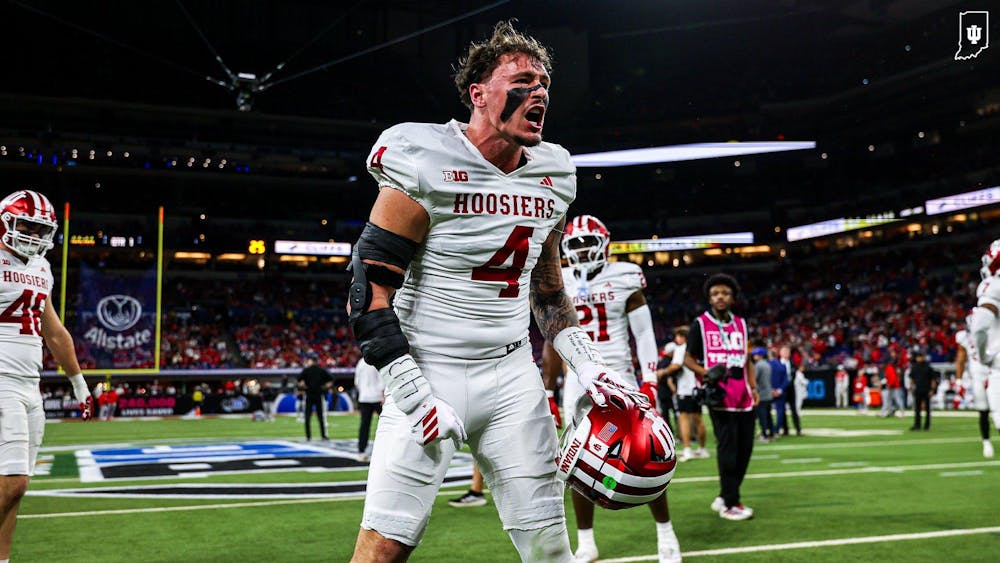
BLOOMINGTON, Ind. – With 2:41 remaining in the fourth quarter of the Big Ten championship game, leading 13-10, Indiana faced a third-and-6 situation.
If unsuccessful in gaining a first down, the Hoosiers will be forced to punt to the Ohio State Buckeyes. Ohio State gained over 70 yards on each of its last two possessions, but a turnover on downs and a missed field goal have helped Indiana retain their lead.
Instead of calling a run and forcing either the two-minute timeout or the Buckeyes to call their final timeout, Coach Curt Cignetti took a chance.
He decided to put the ball in the hands of his soon-to-be Heisman quarterback, Fernando Mendoza, who found his roommate, Charlie Becker, downfield for a 33-yard gain and a near game-sealing first down.
“You've got to get a first down. I wasn't going to punt the ball back to them with two minutes to go and no timeouts. We had to give our guys an opportunity to make plays,” Cignetti said postgame. “We were getting on top of them at certain points in that game, and Fernando was throwing great deep balls. And it was a great play.”
Once again, Indiana had stepped up and succeeded in a high-pressure situation.
Iowa. Check.
Oregon. Check.
Penn State. Check.
Ohio State. Check.
As the confetti fell in Lucas Oil Stadium, a thought that had lingered consistently throughout this season popped up once again.
How has Indiana consistently risen to the moment in the highest-pressure situations throughout the season?
To find answers to this question, it was important to find someone who deals with the area on a scientific level. This ultimately came to be Dr. Jesse Steinfeldt, Ph.D., CMPC, who earned his bachelor’s degree in psychology from Yale University and later his Ph.D. from the University of Wisconsin-Milwaukee. Dr. Steinfeldt is now a sports psychologist and a professor at Indiana University, who created and coordinates the Sports and Performance Psychology Doctoral Minor program.
Dr. Steinfeldt is also the executive producer of the Unit3d Podcast through the Hilinski’s Hope Foundation alongside his B1G Team at Indiana University.
In this interview, Dr. Steinfeldt unpacks what exactly pressure is, how it affects the body, and potential reasons Indiana has found success while under it.
*Disclaimer: Dr. Steinfeldt does not and has never worked with the Indiana football team or any players mentioned*
Simply in terms of sports or even just the general realm, what is pressure?
Pressure, effectively from a cognitive perspective, is a subjective state. It's interpretation, it's an assessment of the situation, and it's interesting because, again, in my field of work, we train athletes cognitively to have a default assessment that's more functional. Meaning, if I see a situation that has, you know, a heightened sort of heightened anxiety around it, you can choose to interpret that as “Oh no,” or you can choose to interpret it as, “Here we go.”
So, part of it is, in sports psychology, we’ll say, it’s okay to have butterflies in your stomach, as long as you teach them to fly in refined formation. So, if you can have a default assumption of your physiological cue as more of an opportunity than a threat, then you see pressure very differently, and then your body responds, and then your actions correspond with that.
In terms of an athlete, or even just a human in general, how does our brain recognize a pressure situation? What are the steps for our brain to get there?
I mean, it’s not really truly like linear and mechanical. I think the most important thing to assert is that people have different paths coming into it, different ways, they, you know, operate in it.
But I think the polyvagal theory, where we're going to talk about trauma responses, where we can have a ventral vagal response of openness. We can have a dorsal vagal shutdown, or in a sympathetic response, where we have a kind of fight or flight perspective. From a neurological perspective, often in a sympathetic response, we can interpret danger differently. The body can operate a space that goes down that path of flight, or you can short-circuit it, cognitively, to the point of training yourself to interpret those cues as, “Okay, it's fight time. It's go time. It's ready to respond time,” versus, “Oh, no, oh, crap, I'm being pulled down this way.”
You said it's kind of a method of short-circuiting. In your field, what are some tactics that you use to help athletes get to that point?
Part of it becomes mapping the student athlete’s mental process of how he or she thinks, and once you do that, you can kind of see where some of the pitfalls are. So, sometimes it's a case where a kid's been, you know, sort of like trained and conditioned to have a negative response. So, for example, a baseball pitcher. If it's a 3-0 count, and I'm here (pitching motion), and my thought is, “don't walk him, don't walk him, don't walk him.” Well, guess what? I'm going to have a higher chance of walking him. Now, if we can redirect that to, “okay, I got this, I'm going to do this,” it doesn't mean you're throw a strike every time, but you have mathematically, statistically, move yourself to a more likelihood of throwing a strike because you're going towards a positive outcome.
So, part of it is understanding language and how language impacts you. Another part is then recognizing what is your default cue. If your default is, “Oh, no,” well, you're probably going to have more negative outcomes than positive outcomes. If your default is, “It's go time, it's actually time.” I'm not letting my body, you know, respond so tightly that the shoulders or the stomach, butterflies, put me down a negative path. If I can just recognize that the body's telling me that it's go time, then more likely, I'm going to have positive outcomes, and I'm going to perform in a more, you know, relaxed, calm way.
That sense of choosing to think of the positive as opposed to the negative. Is that, you know, obviously it's something that you can kind of, like you said, rewire and teach someone. How commonly is that something that some people think and some people don't?
It's a great point. So, Michael Jordan is wired differently, right? Cats like that have a different wiring, and they can, you know, sort of fine-tune it and train it to be even higher, but some people just have a better threshold. Some people naturally have these things. Other people need to have it mechanically, you know, put in place, and then trained, and then they can actively utilize it, but it becomes much more of a trained process than a natural process.
So I guess you think of thresholds. Some people can go a little higher than the others, and then that heightened ceiling, they can sort of tweak it a little bit with work. Other people, they might not be able to get all the way that high, or it takes a lot of work to get up that high.
Another avenue is the idea of clutch. Speaking from your realm and your field, is there such a thing as clutch, or is that just kind of where we put it? Where does that fall into all of this?
Yeah, we call it clutch, but to me, it's about having an elite level of confidence. When I talk with athletes, I work with them, you know, we talk about elite confidence as being irrational, impenetrable, and infectious. The three I's. The idea that it's not bound by math or logic. That I believe in this moment, I am going to be able to do this. I may be 0-for-7, but I'm not thinking about those seven shots I missed. I'm thinking about what’s in front of me in this moment. I'm going to make this shot.
And so, again, some people naturally have it. But again, Michael Jordan, very likely, had a natural proclivity to be able to do that. He trained himself in sports psychology to maximize it. Other people have to work hard to get there, but clutch is really about the ability to have forward-game thinking and move yourself in that space, you know, block out any past. You know, almost irrational. It doesn't make sense, mathematically, if I'm 0-for-7, ah, man, that's not great, screw it, I don't care, I'm going to make this shot, this is what's in front of me. It's only what's in front of me. The elite athletes have that mindset and that elite confidence.
Now moving into the IU football realm. The guy who sticks more than anybody is Fernando Mendoza. He's led multiple game-winning drives, all of them being on the road. What have, from your understanding, what have you seen from Fernando, and where does he get that confidence to be in those pressure situations and rise up?
That's a great question. I want to make sure that I'm not, you know, inserting myself into this space, that I'm not, you know, intimately knowing how he works. From the outside, I would say that just watching him, he's a very loose. A very relaxed persona. And what we find, we talk about flow state, the athletes who are the more paradoxically relaxed, the better you're going to be, versus, sometimes you tighten up so much that you fall off the curve and you can't perform.
He seems to have a generally relaxed air about him. I think that carries itself into those precious situations where he's able to operate and still be calm and not get into that dorsal vagal state where the body is, you know, shutting down. He seems to have good, natural control, if you will, over the way his body flows in those really, really tight moments.
You talked about missing the seven shots, forgetting about those, and going to the next one. He's been fantastic this season after he threw an interception. Against Iowa, against Oregon, against Penn State. He's led the touchdown drives. Is that the same thing?
It's very similar. Back to the idea of the elite confidence, I'm not wasting any cognitive or affective energy on what I did. I'm looking forward. So, I throw an interception, yeah, gone. Goldfish memory, as Ted Lasso says. I am moving forward with what's in front of me.
Now, again, easier said than done. Because you're still like, “Oh, boy, I'm holding on to that. But, if I'd have done this, if I'd done that.” But again, as you can tell, that's clogging up your brain in terms of thinking of what happened versus moving forward.
Now, again, there's time, after the game, for film review, where we'll check those mistakes, and we'll look at that and make the corrective action necessary to be better in the future. But in the moment of competing, there's no reason to have that thought process. Move forward, think about what you're going to do, and he seems to do that.
It seems like Coach Cignetti, the way he orients himself, the way he talks in public. It seems like that's a function of his mindset, and Fernando seems to have a similar one. So you put those together, and it seems to be paying dividends.
There are a lot of guys on this team who are transfers, new guys coming in, a lot of different backgrounds and everything, but it almost seems contagious. It’s not just Fernando; something bad happens, and there are 10 other guys on the offense that, after the interception, lead the touchdown drive. Is this kind of thing contagious?
It's 100% contagious.
I think that comes from the coach. You can have coaches who tighten up and pucker up, and then the kids are going to tighten up and pucker up. If you make a mistake, and your “Oh, what'd you do? What'd you do?” Well, then you're going to create a tightness that's going to then permeate across the other people.
My brother's a college football coach and a high school football coach; he works with the quarterbacks. I love what he says. Whenever a quarterback throws an interception, when he
comes back to him, he never asks, “Why'd you do that?” He always asks, “What did you see?” And so, from that point of what did you see, I can understand what happened. I don't like that you threw an interception, but if I put this sort of tightening frame on you then you're going to tighten up, and you're not going to be ready to rebound and make the next play.
So, it comes from the coach in terms of how he is. Can he be frustrated? Yeah, of course, he'd be frustrated. But how do you orient yourself to your leader? And then how does your leader orient himself to the team? And you're 100% right, it's very much contagious.
And I've seen too many situations where it becomes contagious in the wrong way. One guy's tight and puckered up, and now the next is tight, and now all of a sudden, we're all tentative, and then here we go. Versus relax, flow, whatever, make it happen. Now of a sudden we're on our back foot; two guys are face throwing the ball, and Omar Cooper's making an unbelievable acrobatic play, and that's an iconic moment in Indiana football history.
Bringing Coach Cignetti into this as someone who played football, and he brings the mindset that it seems like you're talking about, very confident, very kind of next thing, not folding under the pressure. How is it different for a coach who’s on the sideline? I know he's having a direct effect on the game, but he's not in the game. How does that work?
Yeah, I think, and this is something my brother always said, too. His coaching doesn't happen on Friday or Saturday. His coaching happens Monday through Thursday. So, all the stuff you put in for the kids, all the preparation, all the work, and then ultimately, now they're prepared to go out there and make the moves they have to make.
So again, yeah, football has some, you know, tweaks in the game clearly, but ultimately, the preparation you've done, the comfort you've conveyed, the way that you coached that kid up, when it comes time for the game, you're going to see it pay dividends and you're not going to have to do a whole lot of microimaging, which then paradoxically becomes the tightening that happens. If you have to on game day, make a lot of changes and a lot of switches, you tighten those kids up and contagiously the rest seem to be tight, and, you know, you have bad things happen.
The Big Ten Championship, extremely high-pressure situation. Same thing as the Rose Bowl, an extremely high-pressure situation. Where does that pressure go in these three weeks in between the two games?
It goes down. And I think the other thing that the coaches are going to do is simulate pressure situations in practice so that when they get to the game, it's natural. You hear this all sorts of times, like coaches pumping in music, different sorts of environmental factors that try to replicate what's going to be in the game. So, they're going to practice in a way that creates the same level of, you know, potential pressure so that they can respond to it in time, in practice, and then it comes to the game. It's more of a natural move.
One point when Indiana wasn't clutch or didn't perform under pressure this season. Nico Radicic's kick in the Big Ten that he missed. He hadn’t missed a kick this season, but the highest-pressure kick he had so far didn't go. Where does that come from?
Great question. I don't know. So again, not knowing that kid well enough to know what's going on between his ears or, more importantly, what he's being told, fed, and prepared with, I don't know that. It looked like someone who got tight and tentative, and the result, again, showed, but I don't know what led to that and what, you know, contributes to that.
I feel for the kid, I'll say that. Watching the game, I was like, “Dude, take the camera off that guy.” They kept showing him, like, dude, leave him be, you know? It's unfortunate. It’s a kid, it's a moment, it sucks. He knows it sucks. But the idea of that big pressure moment, apparently, it did get to him because that was not just a miss. That was a shank miss. And so that tells me there's a level of tightness.
But where it came from, I don't know, because I wasn’t on the sidelines. It's hard to know. More importantly, I wasn't in practice or the locker room. And also, the other part of this, these kids aren't robots. I mean, they go out there, they perform unbelievable physical feats, but they cry, they hurt, they bleed, they go to class, you know, their girlfriends break up with them. All these things that are happening, we don't know how it could be, you know, cumulatively impacting them, and all of a sudden, they blow up at the wrong moment.
Take a moment like that where you didn’t rise to the occasion and now come Rose Bowl time. What are your tactics to get him to make that kick the next time?
Back to the elite confidence concept. We talked about the irrational piece. We talked with the impenetrable peace. Part of it is, you know, we train athletes to think like a bad accountant. So,
I'm only cherry-picking the positive things and carrying forward. I'm forgetting the negative half of the curb. I'm forgetting the negative stuff; I don't even carry it forward. It’s gone. I'm only thinking about stacking W’s on the positive side of the ledger.
Again, it takes some training to do, and you recognize that it’s not rational, but who cares? Elite level confidence is one where right now doesn't matter what I did. I know I can do it. I'm going to make this happen. So the seven missed shots, or that kid who shanked the field goal, he's going to have to work on getting that as far off his memory as possible.
Stack the ones you make while forgetting those others, screw them. I'm a bad accountant. I'm counting the W’s. Again, not a reasonable, not a logical, not a rational thing, but the elite confidence is none of those things. Elite confidence is about this moment in front of me.
The old Indiana would have thought, if we play Ohio State 100 times, we'd lose 99 times. But the elite confidence would say this is the one time right now. If I lose that game, then next time is the one time. We've moved away from that. Now, the ability is maybe we're going to beat them one time out of two. I like our odds. And I think that's a little bit of the Cignetti confidence that, again, gets conveyed to the team and has a contagious effect.
Ultimately, I'll say, pressure is a choice. Now, the body can push down a path, but pressure is a choice of how I choose to interpret the situation. The great ones choose to see it as an opportunity rather than following a negative path.